Three Interactive Archaeological & Engineering Workbenches
Interactive Historical Laboratories
Hands-on instruments built specifically for second-century BCE Punic Carthage, Numidia, and Republican Rome: guest-token fracture geometry, pure vector museum epigraphy, Sinus Uticensis shoreline progradation, and ancient siege metrology.
Laboratory 01 · Hospitality Law & Four-Script Epigraphy
Three-Piece Ivory Boar Tessera & Four-Script Workbench
Inspect how the sleeping yellow ivory boar from Chapters 4 and 8 splits first lengthwise along the spine (Archaic Etruscan underside) and then crosswise over a Carthage quay bollard into three unforgeable pieces — paired with pure vector SVG epigraphy.
The Matched Sleeping Boar (Four Generations of Guest-Friendship)
Matched across Baʿalḥanno's cedar box (Carthage) & Paquius's leather neck-pouch (Capua)
Laid edge-to-edge on white linen at the Megara winter feast, the two yellow ivory halves form a small sleeping boar whose lengthwise seam almost vanishes. Modelled on the real 6th-century BCE Etruscan ivory boar tessera hospitalis excavated at Sainte-Monique, Carthage (TLE 724, Bardo Museum).
Four-Script Vector Epigraphy Comparator
Rendered strictly as inline geometric vector paths from 2nd-century BCE CIS I Punic, Dougga RIL 2 Libyco-Berber, TLE 724 Etruscan, CIL I² Old Latin, and Polybian Greek — zero archaic Phoenician or modern Neo-Tifinagh system fonts.
How Rome's deditio decree promised Carthage its laws and territory while omitting the physical city (polis / urbs).
Late Punic Cursive-Lapidary (CIS I / Carthage)
Qart-Hadasht ('New City') · Citizens & Senate (adirim)
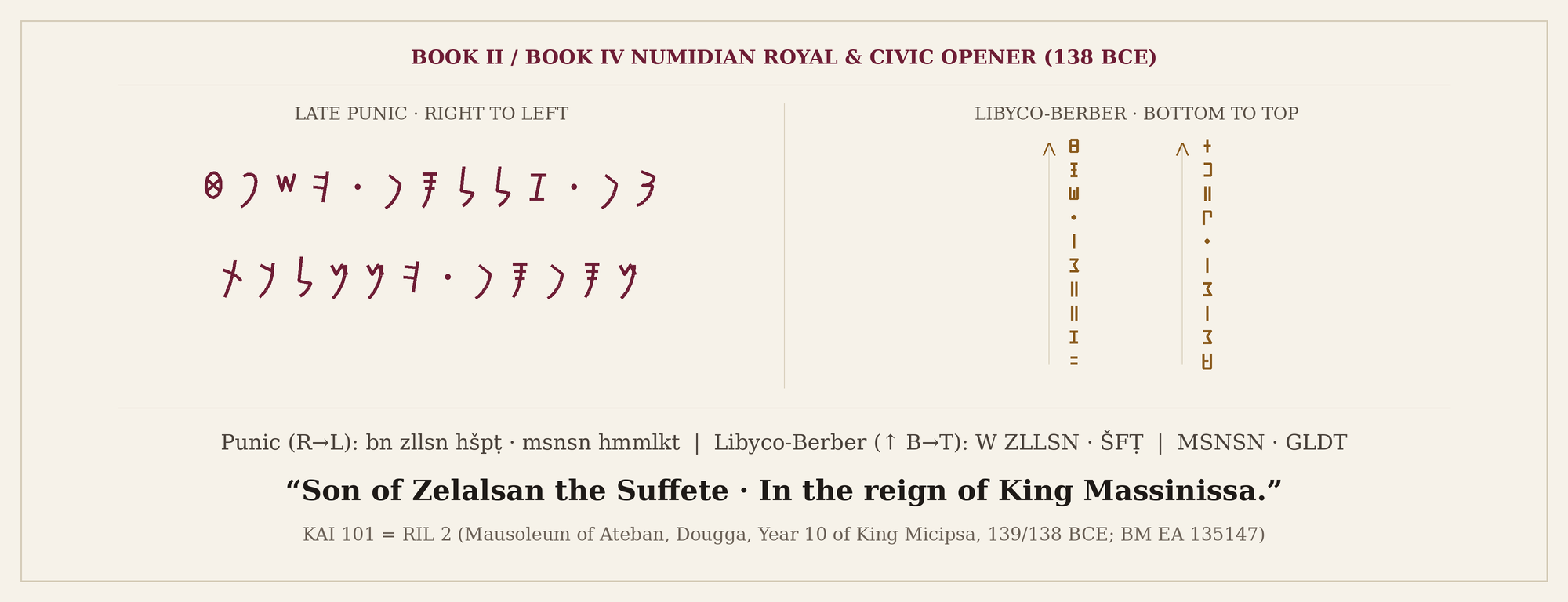
Monumental Libyco-Berber (RIL 2 = KAI 101, Dougga 139/138 BCE)
Civic magistrate title ŠFṬ ('suffete') shared across Punic & Numidian statecraft on the Dougga bilingual stone
Mid-Republican Old Latin (Senatorial & CIL I² 585 Register)
Rome granted the civitas (citizen community) freedom while withholding urbs (walled physical masonry); by 111 BCE CIL I² 585 surveyed the soil as ager in Africa.
Hellenistic Diplomatic Greek (Polybius 36.4.4)
Copied by the Achaean consular clerk in Interlude I: Rome's urban praetor guaranteed autonomy, laws, territory, and possessions, silently leaving out polis.
Cut left-handed by fifteen-year-old Arish in his uncle's stele yard beside the Tophet after Oroscopa.
Standard Carthaginian Votive Formula (CIS I)
'To the Lady Tanit Face-of-Baʿal and to the Lord Baʿal Hammon [because He heard his voice]'
Dougga Royal Lineage Register (RIL 2 = KAI 101)
Massinissa, son of Gaia (GYY), son of Suffete Zelalsan (ZLLSN) — verified bilingual anchor for Numidian names
Campanian & Roman Hospitality Register (CIL X 874 / 883)
Verified 2nd-century BCE Oscan/Campanian gentilicium at Capua and Pompeii paired with hereditary guest-friendship.
Greek Ethnographic & Treaty Register (Appian, Punica 74–93)
Three hundred noble hostages, two hundred thousand panoplies, and two thousand torsion engines surrendered at Utica.
How three Punic protagonist names map directly onto CIS I stelae while Gaisan is transparently flagged as an analogical Numidian coin.
Attested Punic Personal Names (CIS I)
Mattanbaʿal ('Gift of Baʿal', f.), Himilkat ('Brother of the Queen', m.), Arish ('Desired', m. — never female Arishat)
Epigraphic Restraint: Attested Root GYY vs Unattested 'Gaisan'
Gaisan combines the attested royal root Gaia (GYY) with the -san suffix of Zelalsan (ZLLSN). Because GYSN is unattested on stone, we refuse to carve fake Libyco-Berber glyphs for it.
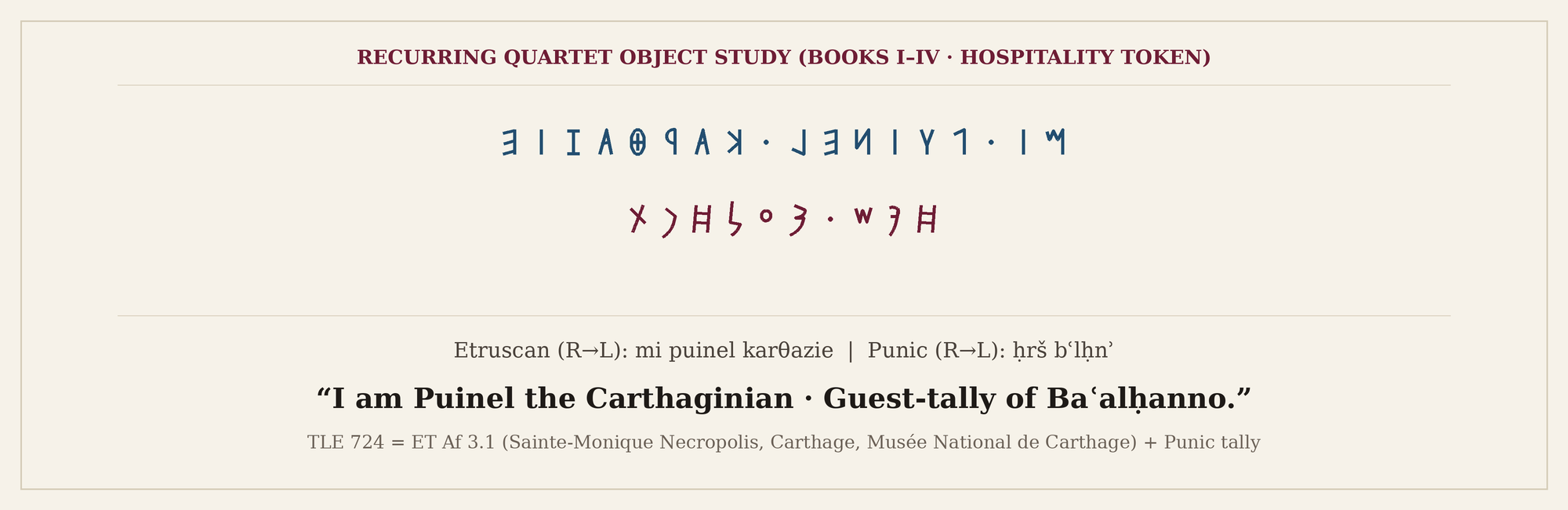
Archaic Etruscan Guest-Token Parallel (TLE 724, Carthage)
Modelled on the real 6th-century BCE ivory boar tessera hospitalis excavated at Sainte-Monique, Carthage: 'I am Puinel the Carthaginian'.
Roman Prosopography of 149 BCE (Polybius 36.5.8)
Biological sons of L. Aemilius Paullus: elder brother Fabius receives the 300 hostages at Lilybaeum while younger brother Scipio serves as military tribune in Africa.
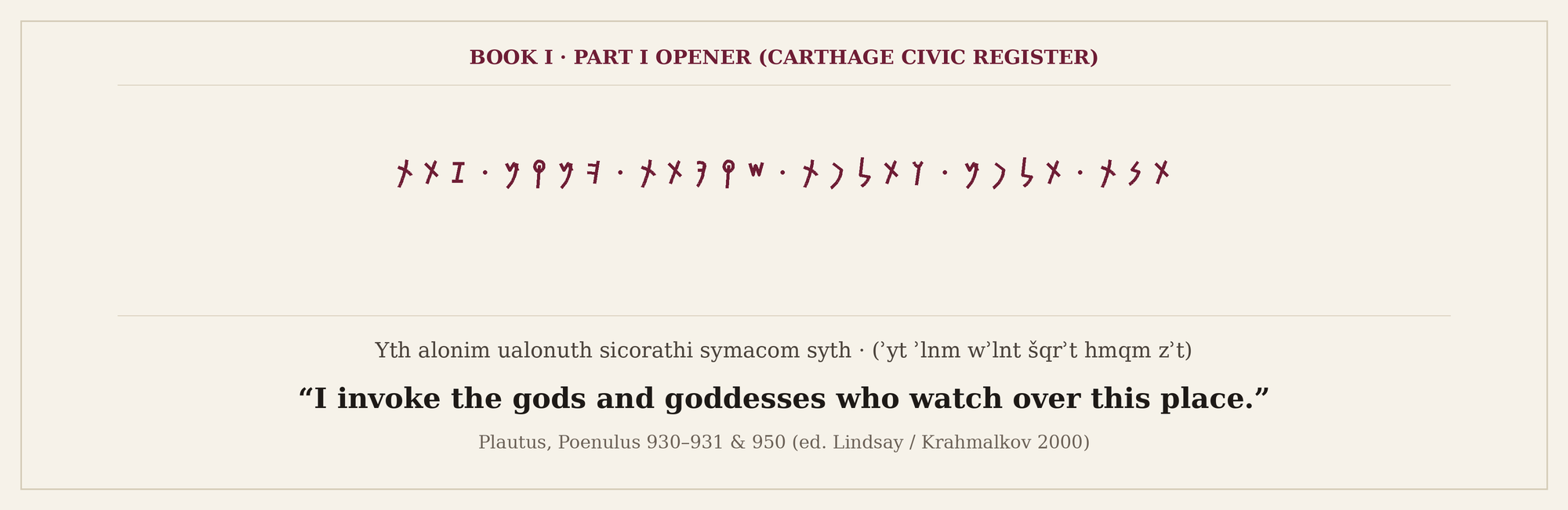
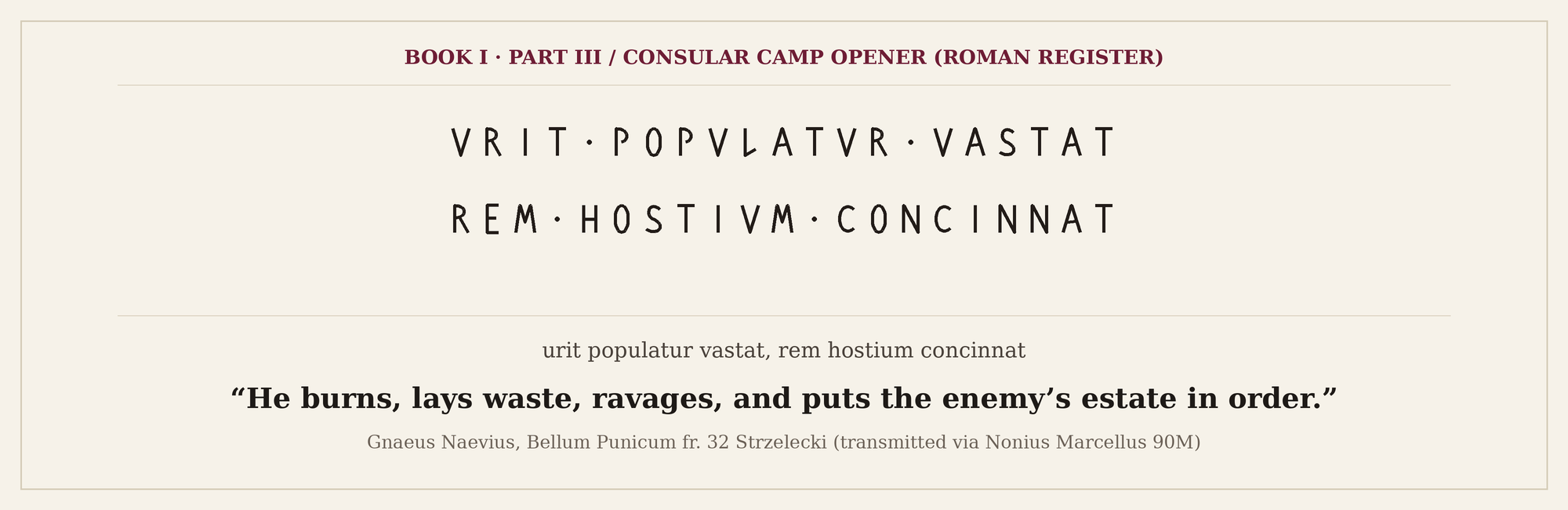
Bilingual Part-Opener Cartouche Studio (600 DPI + Vector SVG)
Warm Limestone #F6F2E9 · Night-Mode SafeFive attested ancient inscriptions rendered both as pure geometric vector plates and as 600-DPI warm-limestone cartouches framed in a hairline border so dark-mode e-readers never invert or swallow ancient ink strokes.

Laboratory 02 · Paleoshoreline Geoarchaeology & Fortifications
Ancient vs Modern Coastline Explorer (149 BCE vs 2026 CE)
See why Utica was a deep-water Roman landing port in 149 BCE before Medjerda (Bagradas) river siltation pushed the modern Tunisian coast ~11 km northeastward, and step across Carthage’s peninsula cross-section.
Utica (149 BCE Coastal Seaport)
In 149 BCE Utica stood on a limestone maritime headland commanding the Gulf of Utica, where Manilius and Censorinus landed 80,000 Roman troops (Appian 75). Over the next two millennia, Medjerda (Bagradas) river alluvium pushed the shoreline ~11 km north-east, leaving Utica's quays dry among inland wheat fields.
Carthage Peninsula & Siege Engineering Cross-Section (Stations 1–5)
Click any numbered station across the peninsula profile to inspect excavation dimensions from Hurst (1994), Lancel (1995), Rakob (1991), and Appian.
1 · Taenia Sandspit & Censorinus's Twin Ram Causeway (149 BCE)
Between the open Gulf and the shallow, stagnant Lake of Tunis (Stagnum) ran a narrow tongue of sand. Repulsed twice from the walls, Consul Censorinus dumped earth along the lagoon edge to gain room for two giant battering rams — one hauled by 6,000 legionaries under military tribunes, the other by 6,000 fleet oarsmen racing them in service rivalry (Book I, Ch 17–18).
Laboratory 03 · Ancient Metrology, Slipway Physics & Torsion
Ancient Measures, Punic Rations & Torsion Calculator
Narrative prose in Qart-Hadasht uses strictly ancient Mediterranean measures. Convert distances, calculate dry-grain rations and cistern jars, and test 1-in-10 Cothon trireme ramp loads and hair-skein catapult output.
Narrative Distance & Architecture Converter
Rations, 1-in-10 Slipway Haul & Hair-Levy Torsion
Ch 1 places 40 men and 8 boys (48 haulers) on the ropes of a stripped trireme (~22 tonnes) up a greased 1-in-10 stone-and-sleeper ramp assisted by the top capstan.
| Dry / Liquid / Bullion Unit | Modern Equivalent | Historical & Narrative Context |
|---|---|---|
| Choinix (daily soldier/hostage grain ration) | 1.08 litres (~0.82 kg dry wheat) | Standard Polybian daily dry-grain ration for one foot-soldier or Tiber navalia hostage (~2,700 kcal before milling loss). |
| Punic Kad (amphora / household storage jar) | ~21.5 litres (~16.5 kg grain / ~21.5 kg water) | Commercial Punic transport and cistern-jar measure; Mattanbaʿal counts dry barley kad jars under her breath at the postern door in Ch 13. |
| Carthaginian Shekel (late billon / silver standard) | ~7.35 grams | Punic monetary unit (~7.2–7.6 g); in Ch 6 outlawed Hasdrubal pays Bagradas recruits in debased late-Punic billon shekels. |
| Mina (60 Punic / 100 Attic drachmae · cord lot) | ~436 grams (~0.96 lb) | Standard workshop weight in Ch 16's temple loft for boiled, oil-dressed women's hair torsion skeins (tonoi). |
| Euboic / Attic Silver Talent (60 minae) | ~26.2 kilograms (~57.8 lb silver) | Carthage's 201 BCE treaty indemnity of 10,000 talents over 50 years equalled 200 talents (~5,240 kg of silver) shipped to Rome every single year until 151 BCE. |